Four of Cups and the Tower Together: Tarot Combination Meaning
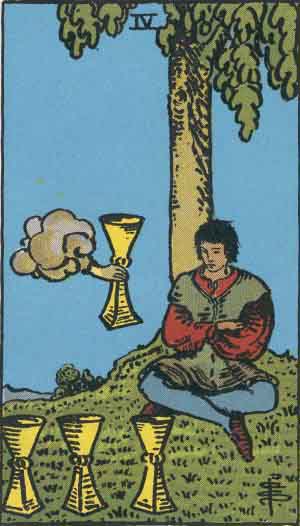
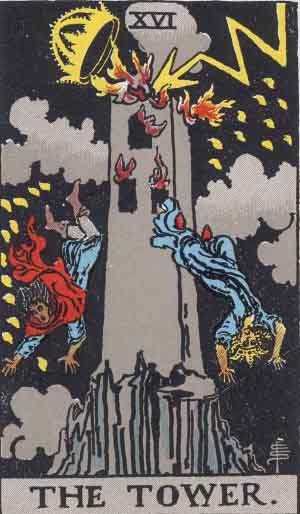
The Four of Cups and the Tower are easy to turn into a frightening story: someone ignores an offer, then everything collapses. That is only one possible narrative, and the cards cannot verify it. The Rider-Waite-Smith Four of Cups shows a seated figure looking toward three cups while a fourth is offered from a cloud. The Tower shows lightning striking a high structure and people falling from it. Put together, the images can start a more useful inquiry: what has stopped feeling meaningful, and which belief about the situation might need examination?
Put the cards into positions
Try the free three-card tarot reading with a specific question. Name each position before you draw and note the order of the cards. A position can change the interpretation more than a generic combination keyword. No account is required.
Read the images before the headline
In A. E. Waite's account, the Four of Cups figure is dissatisfied even as another cup is presented. The image does not tell us whether the offer is good, whether the figure should accept it, or whether a pause is unreasonable. In a reading, distinguish fatigue from a considered refusal. Ask what the person actually wants, what has been offered, and whether the offer addresses that need. A choice to rest can be different from missing an opportunity.
Waite presents the Tower as a rupture in a structure and devotes attention to a false or unstable foundation. Its imagery is intense, but it does not turn a reading into a factual forecast. For reflection, the structure might be a plan, an expectation, an explanation or a role that no longer fits. Ask which part can be checked against evidence. Do not assume the Tower always refers to an external event; a change in understanding can be disruptive enough.
Order and spread position
If the Four of Cups appears in a Present position and the Tower in an Advice position, the reading might ask whether disengagement is protecting an assumption from scrutiny. Advice here is not an instruction to provoke conflict. It could mean asking a direct question, reviewing facts or making room for an unwelcome answer. If the Tower appears in a Past position and the Four of Cups in the Present, the quiet figure might represent a pause after upheaval. That is a different sequence: recovery before another decision.
If both cards are adjacent without named positions, do not invent a timeline. Compare the scale of the scenes: a private refusal under a tree and a public, dramatic break in the image of a tower. Which scale belongs to the actual question? A third card or the question itself may narrow the focus. A card in an Outcome position is still a symbolic prompt, not proof that a future disruption is certain.
Relationships and work
In a relationship reading, the Four of Cups might prompt a conversation about emotional distance or an offer that does not meet a real need. The Tower can ask whether a shared assumption is sustainable. Neither card gives access to another person's thoughts. If a conversation is possible and welcome, name the observable behaviour and ask what the other person wants rather than announcing a breakup based on a spread. Respect a request for space or no contact.
In a work reading, this pair can be used to examine a stalled proposal. The Four of Cups asks why the proposed opportunity feels unappealing; the Tower asks what would happen to the plan if an important assumption proved false. Write down the assumption, the evidence for it and a reversible next step. This is a planning exercise, not a prediction of job loss or financial advice. Real contracts, deadlines and professional guidance take precedence over cards.
Reversals and a grounded exercise
Waite lists novelty and new instruction among the reversed Four of Cups meanings. His treatment of the reversed Tower is not a simple promise that disruption disappears. Modern readers use several reversal systems, and some ignore orientation entirely. Pick a method before drawing. A reversal might shift attention from an old response to a new one, but the actual spread and circumstances still decide whether that reading is useful.
Write three lines after your reading: what offer or option is visible, what assumption supports the current plan, and what small action could test it without creating unnecessary harm? Return to those notes after a real conversation or new information. If the interpretation feels alarming, set the cards down and consult the people or professionals who can address the actual situation. Tarot is a reflective practice, not a way to diagnose a condition or establish a future event.
Frequently asked questions
What do the Four of Cups and the Tower mean together?
The Four of Cups can ask what has become difficult to notice or accept; the Tower can ask what assumption is being challenged. In a spread, read their positions and the real situation before deciding whether the pairing describes a change in perspective, a difficult conversation or something else.
Does this pair predict a breakup or catastrophe?
No. Tarot cannot establish that an event will occur. The Tower is a dramatic image, but a card is not evidence of a future accident, breakup or loss. Use the spread to frame questions about what you know and what choices are available.
How do reversals change this combination?
Only within a reversal method chosen before the reading. A reversed Four of Cups might invite renewed attention; a reversed Tower need not mean a crisis has been avoided. Read the cards in their positions and avoid treating a reversal as a guaranteed outcome.
Source and reading context
The card imagery and historic meanings are described in A. E. Waite's The Pictorial Key to the Tarot, illustrated by Pamela Colman Smith: Four of Cups, the Tower image and symbolism, and the Tower's divinatory notes. The combined examples above are this guide's own reflection prompts, not predictive claims by Waite.