Six of Cups and Six of Pentacles Together: Meaning in a Tarot Spread
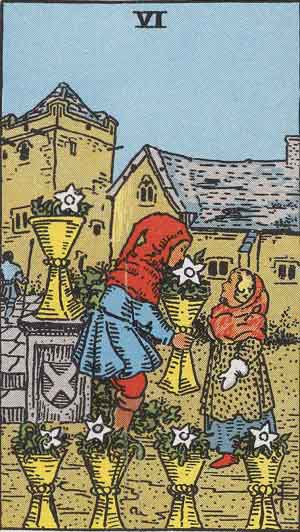
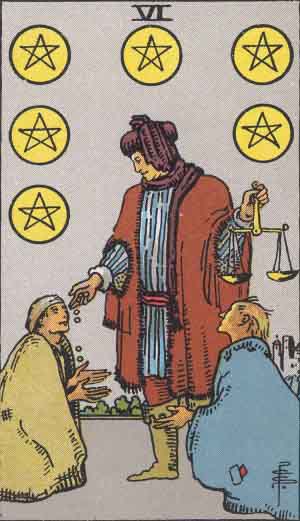
The Six of Cups beside the Six of Pentacles joins a remembered connection with a visible exchange. That does not translate into one fixed outcome. In the Rider-Waite-Smith deck, the first card depicts children and flower-filled cups in an old garden; the second shows a figure weighing money before giving it away. One image invites a look back, while the other asks who can give, who receives, and on what terms. The reading becomes useful when those questions are attached to actual spread positions.
Try the pair in a real spread
Use the free three-card tarot reading with a specific, open question. Record each card's position and orientation before reading a combination. You can also return to the tarot library to compare spreads. No account is required.
Begin with each image, then find the bridge
A. E. Waite's account associates the Six of Cups with past experience and memory. It is tempting to flatten that into nostalgia or a prediction that someone from childhood will appear. The card's flowers are a more precise prompt: what did an earlier connection make possible, and which part belongs to the past rather than the present? A fond memory can be valuable even when it is not a plan to repeat the same relationship.
Waite describes the Six of Pentacles as a person with scales who distributes resources. The scales matter as much as the gift. Look at capacity, fairness and power in a concrete situation. Is the help freely offered? Has the recipient been asked what is useful? Does the giver expect access or gratitude in exchange? Reading the two cards together can turn a vague feeling of loyalty into a specific conversation about support and boundaries. It does not require giving money or imply that generosity earns affection.
Order and position change the question
If the Six of Cups lands in a Past position and the Six of Pentacles in a Present or Action position, an old bond may be informing today's choice to help. The practical task is to check whether the old understanding still applies. If the Six of Pentacles appears first and the Six of Cups sits in an Outcome position, an exchange may bring up memories or a sense of familiarity. An Outcome position in a tarot spread is a reflection prompt, not evidence that a particular person will come back.
If the two cards are simply adjacent without named positions, do not invent a timeline. Compare their figures instead: childhood and adulthood, receiving a small symbolic offering and distributing measured material support. Ask which scene resembles the situation now. A third card can supply context, but it should not be used to override what the people involved actually say and do.
Relationships: kindness without a debt
In a relationship question, the pair can suggest remembering a previous kindness while evaluating the present balance of care. For example, someone may want to help an old friend through a difficult month. The Six of Cups can name why the history matters; the Six of Pentacles can ask whether the proposed help is welcome, affordable and clearly bounded. The cards cannot tell you whether the friend will reciprocate or whether a former partner will reconnect.
For a reconciliation question, separate memory from consent. List what you know directly, what you are assuming, and what you would need to ask. Do not offer money, gifts or repeated contact as a way to secure an emotional answer. A tarot interpretation should never be used to excuse pressure on another person.
Work and resources: make support concrete
In a work or community reading, the Six of Cups might point to an earlier mentor, a familiar practice or a project with a long history. The Six of Pentacles then asks how time, credit or resources are allocated today. A useful next step could be to specify who needs help, what can be offered, how long it will last and when to review it. This is a way of testing the reading against reality, not financial advice or a forecast of payment.
Notice the difference between receiving support and being made dependent on it. The giver in the image holds the scales; the reader should ask who sets the terms. The same question applies when you are the giver. Support is more ethical when the recipient has a meaningful choice and the giver can state a limit without resentment.
Reversals and a short reading exercise
There is no universal rule that a reversed card means the opposite of its upright meaning. Waite's reversed Six of Cups points toward future renewal, while his reversed Six of Pentacles includes desire and envy among its possible meanings. Modern readers may use reversals differently or not at all. Decide your method before the draw and keep it consistent. In this pair, a reversal might invite a check on whether memory is idealised or an exchange feels unfair; it does not prove either condition exists.
Write three sentences after the draw: what earlier experience is influencing this question, what is actually being exchanged now, and what boundary or request would make the exchange clearer? Check the answers against the real situation. If a card appears in a named spread position, include that position in your notes. If the interpretation stops being useful, set it aside rather than drawing until you receive a preferred answer.
Tarot is a symbolic practice, not a way to verify another person's thoughts, diagnose a problem or guarantee a future event. The methodology and privacy policy explain the site's tools and data handling.
Frequently asked questions
What do the Six of Cups and Six of Pentacles mean together?
In a Rider-Waite-Smith reading, the Six of Cups can bring memory and an earlier relationship into view, while the Six of Pentacles asks what is actually being given or received now. Read the spread positions before deciding whether this is about care, obligation or an unequal exchange.
Do these cards mean an ex will return?
No. A memory-focused card cannot establish another person's intentions or predict contact. If the question concerns a past relationship, examine present behaviour, consent and the practical terms of any proposed exchange.
Does reversing either card make the combination negative?
Not automatically. Reversals depend on the reading method. They can invite questions about a memory that needs updating or an exchange that feels unbalanced, but the position and surrounding cards still matter.
Source and reading context
The card images and original divinatory notes are described in A. E. Waite's The Pictorial Key to the Tarot: Six of Cups and Six of Pentacles, illustrated by Pamela Colman Smith. The combined examples and practical questions here are this guide's own interpretation, not claims made by Waite or evidence of predictive accuracy.