
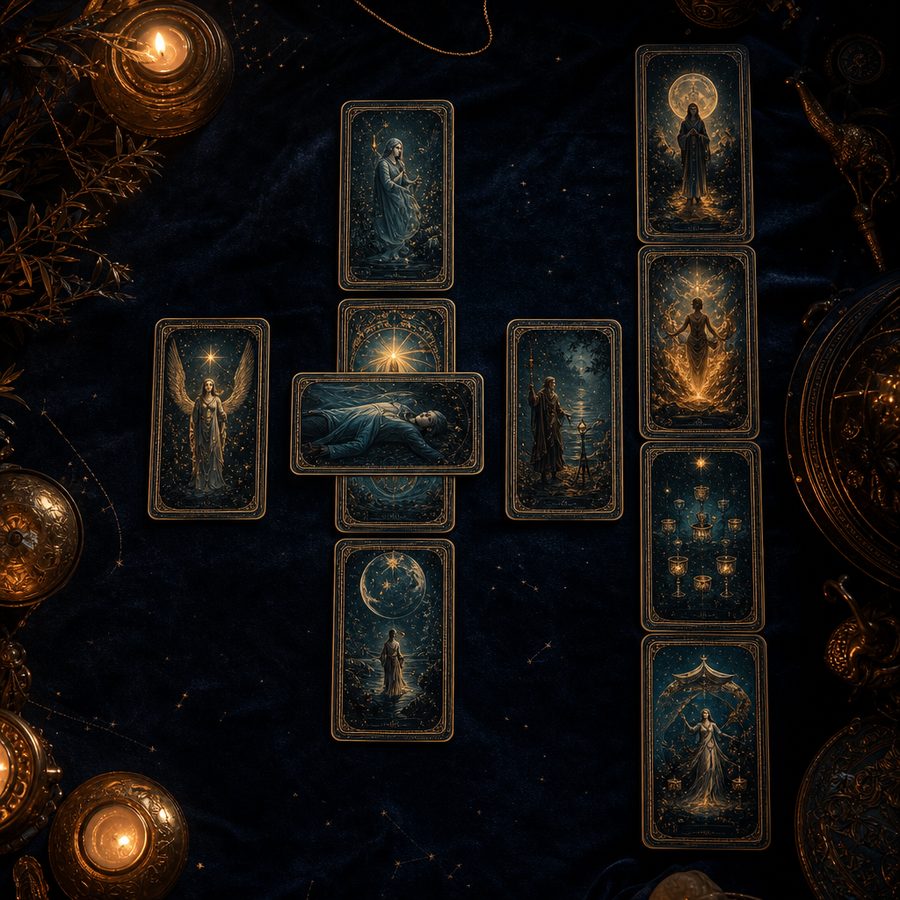
Celtic Cross Tarot Spread
In short: Draw a free ten-card Celtic Cross from the full 78-card deck and read each card in its position, from the present situation to the likely outcome. Select any position to see the card, its keywords and a reading written for that position. No sign-up is required.
How to use the Celtic Cross tool
- Hold a question or situation in mind. The Celtic Cross works best for something with several moving parts.
- Select Draw Spread. Ten cards are dealt into numbered positions.
- Select position 01 to open the first card, then use the arrows to step through to position 10.
- Download the spread as an image, or select Draw Again for a new spread.
The tool lists the positions in order rather than drawing the cross shape, so you can read them one at a time on any screen.
The ten Celtic Cross positions
| No. | Position | What it covers |
|---|---|---|
| 1 | Present | The heart of the matter |
| 2 | Challenge | What crosses or complicates it |
| 3 | Foundation | The root cause or subconscious basis |
| 4 | Recent past | What is passing or has just left |
| 5 | Crown | Highest potential, what could be |
| 6 | Near future | What is approaching |
| 7 | Self | Your attitude and inner state |
| 8 | External | How others see you, or influences around you |
| 9 | Hopes and fears | What you hope for or fear |
| 10 | Outcome | The likely result if you stay this course |
Books and teachers name and order a few of these positions differently. The labels above are the ones this tool uses.
What you see for each card
- The card image and name, with a reversed marker when it is upside down.
- The card's keywords, its element where one is listed, and whether it is Major or Minor Arcana.
- A reading for the card upright or reversed in that particular position. A reversed Challenge card, for example, is read as an obstacle that may be largely internal.
Each position is interpreted on its own. The tool does not write a single summary of all ten cards, so the guide below covers how to link them.
How to read a Celtic Cross
In the traditional layout, the first six cards form the cross and the last four form a column beside it, often called the staff. Reading the cards in pairs makes the spread easier to follow:
- Cards 1 and 2: the situation and what is pushing against it. Read these two together before anything else.
- Cards 3 and 5: what lies underneath the question and what you are aiming for. A gap between them can show where effort is needed.
- Cards 4 and 6: what is leaving and what is arriving. Together they show the direction of movement.
- Cards 7 and 8: how you approach the matter and the people or conditions around you.
- Cards 9 and 10: your hopes or fears, then the likely result if nothing changes. If the outcome is unwelcome, look back at cards 2 and 7 for what you could change.
Across the whole spread, notice repeated suits and the number of Major Arcana cards. Each card has about a 30 percent chance of being drawn reversed, and no card can appear twice.
When to use the Celtic Cross
The Celtic Cross suits complex or long-running questions, such as a relationship that keeps circling the same problem or a career decision with several factors. For a quick check-in, a three-card spread is easier, and for a simple decision a one-card yes or no draw is quicker. The meanings are traditional interpretations for reflection, not predictions.
Questions people ask
What are the 10 positions in a Celtic Cross?
In this tool they are Present, Challenge, Foundation, Recent past, Crown, Near future, Self, External, Hopes and fears, and Outcome. Some books order or name a few positions differently.
Which card is the outcome?
Card 10. Here it describes the likely result if you stay on your current course, so it reflects the direction things are moving rather than a fixed event.
How long does a Celtic Cross reading take?
It takes longer than a three-card spread because there are ten positions to read and compare. Working through the cards in pairs makes it easier to follow.
Is the Celtic Cross good for yes or no questions?
It is better suited to complex or long-running questions. For a simple yes or no, a single card draw is quicker.
What does a reversed Challenge card mean?
In this tool a reversed Challenge card suggests the obstacle may be largely internal, such as a pattern or fear that you have more influence over than it first seems.
More free tools
Continue only if it fits your question
Explore Chaya's written readings
Links open a separate site with its own policies. Your birth details and email are not shared.