Moon Phase Calculator
In short: Choose a date and local time from 1800 through 2399 to see the Moon phase name, illuminated fraction, estimated lunar age, waxing or waning direction, and the Moon's zodiac sign and degree. It opens on today's date and updates as you change the inputs. It is free, with no sign-up.
How to use the moon phase calculator
- Pick a date. The calculator opens on today's date.
- Set a local time. It starts at 12:00; select Now to use the current date and time.
- Use the minus and plus buttons to step back or forward one day at a time.
- Read the result, which updates automatically, and download it as an image if you want to keep it.
The time is read in your device's time zone rules for that date. To check a birthday from another country, convert the birth time to your own zone first, or compare calculators at the same UTC instant.
What the result shows
- Phase name: one of the eight phases, with a drawing of the lit part of the Moon.
- Illumination: the illuminated fraction of the lunar disk, shown as a percentage.
- Lunar age: an estimate of days since New Moon.
- Direction: waxing while the lit part is growing toward Full Moon, waning after it.
- Moon sign: the Moon's tropical zodiac sign with degree and minute.
- Phase notes: a short astronomical description and a separate symbolic reflection.
The eight moon phases
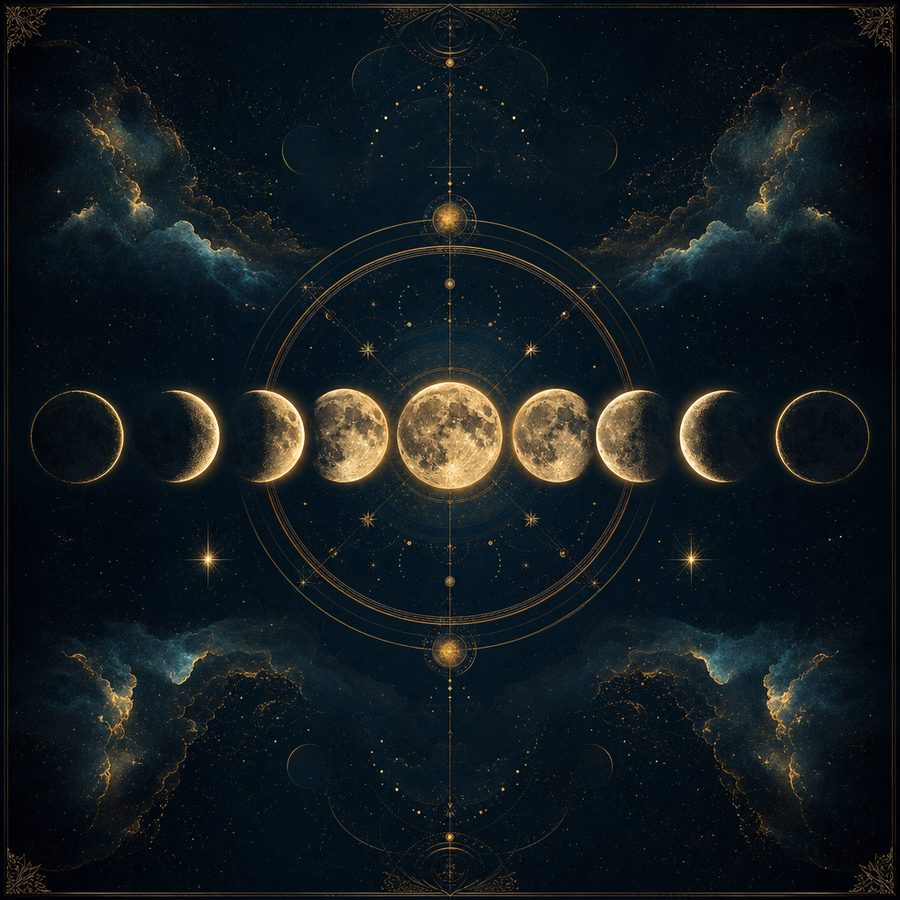
The Moon cycles through eight phases roughly every 29.5 days: New Moon, Waxing Crescent, First Quarter, Waxing Gibbous, Full Moon, Waning Gibbous, Last Quarter, and Waning Crescent. The calculator names the phase from the angle between the Sun and Moon along the zodiac, giving each phase a 45 degree band.
| Phase | Sun-Moon angle | What is happening |
|---|---|---|
| New Moon | Within 22.5 degrees of 0 | The Moon is aligned with the Sun and largely hidden |
| Waxing Crescent | 22.5 to 67.5 degrees | A thin lit edge is growing |
| First Quarter | 67.5 to 112.5 degrees | About half the disk is lit |
| Waxing Gibbous | 112.5 to 157.5 degrees | More than half is lit and Full Moon is approaching |
| Full Moon | 157.5 to 202.5 degrees | The Moon is opposite the Sun and almost fully lit |
| Waning Gibbous | 202.5 to 247.5 degrees | Illumination is decreasing |
| Last Quarter | 247.5 to 292.5 degrees | About half the disk is lit again |
| Waning Crescent | 292.5 to 337.5 degrees | A narrowing crescent before the next New Moon |
Moon phase meanings for reflection
Each phase also includes a separate symbolic reflection, not an astronomical prediction. In brief, the New Moon is used for setting an intention, the Waxing Crescent for giving a plan steady attention, the First Quarter for a decision that keeps things moving, and the Waxing Gibbous for refining details. The Full Moon is used for reviewing what has become visible, the Waning Gibbous for sharing what you learned, the Last Quarter for clearing unfinished business, and the Waning Crescent for rest before the next cycle.
How the calculation works
The tool determines the phase name from the geocentric tropical Sun-Moon longitude difference and gets the illuminated fraction of the lunar disk from Swiss Ephemeris's lunar phenomena calculation. These are related but distinct measurements. Lunar age is estimated from the longitude difference and a mean synodic month rather than measured as the elapsed time since the previous exact New Moon.
Because each phase name covers a 45 degree band, a label such as Full Moon applies for about two days either side of the exact moment. For exact New Moon, quarter and Full Moon times, browse all 2027 New Moon, quarter Moon, and Full Moon dates.
For independent checks, compare phase dates with the U.S. Naval Observatory phase table and the illumination definition with its Moon fraction guide. Use the same UTC instant and timezone when comparing calculators. The Swiss Ephemeris programming guide documents the lunar illuminated fraction returned by the phenomena function.
What the tool does not do
The calculator does not give moonrise or moonset times, local visibility, or eclipse predictions, and it does not ask for your location. The reflections are symbolic prompts, separate from the astronomy.
Questions people ask
What phase is the Moon in today?
The calculator opens on today's date at 12:00 in your local time. Select Now to use the current time, and the phase, illumination and Moon sign update straight away.
Can I find the Moon phase on my birthday?
Yes. Enter your birth date and, if you know it, your birth time. Any date from 1800 through 2399 is supported, and the time is read in your device's time zone, so convert a birth time from another zone first.
Why does it say Full Moon when the exact Full Moon was yesterday?
Each phase name covers a 45 degree band of the Sun-Moon angle, so the Full Moon label applies for about two days either side of the exact moment. Check the illumination figure or the 2027 calendar for exact times.
What is the difference between moon phase and illumination?
The phase describes the angle between the Sun and Moon as seen from Earth, while illumination is the fraction of the Moon's disk that is lit. They are related but distinct measurements.
Is the Moon phase the same everywhere on Earth?
At a given instant the phase is essentially the same worldwide, but the local date and clock time differ by time zone. Use the same UTC instant when comparing calculators.
More free tools
Continue only if it fits your question
Explore Chaya's written readings
Links open a separate site with its own policies. Your birth details and email are not shared.